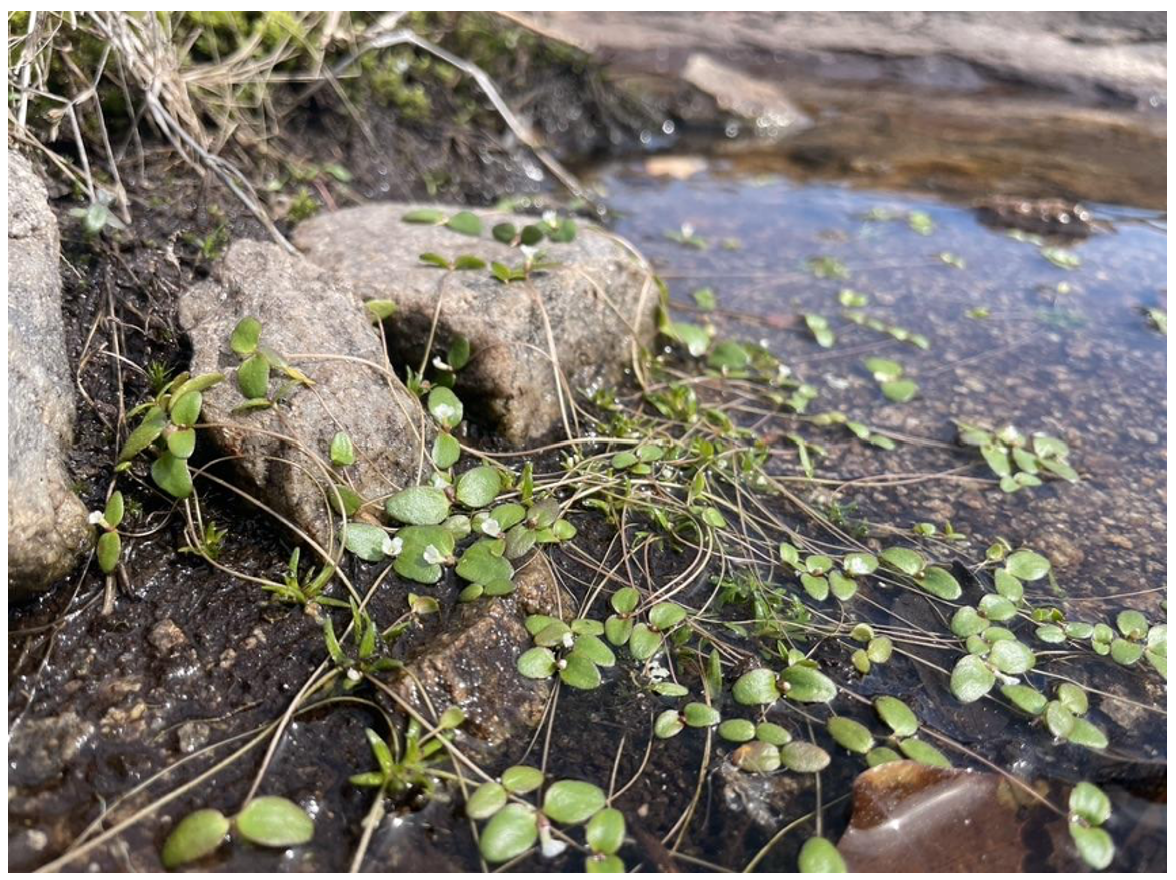
Winter isn’t when most people expect to go out looking for rare plants. Yet, for the past four years in Georgia, I’ve spent cold mornings trekking across bare rock, datasheets in hand and HotHands in pocket. I’m searching for a tiny, rare plant that only grows in the shallow pools atop solid granite outcrops. Snorkelwort, also called pool-sprite, or little amphianthus, resembles little lily pads and has a suite of remarkable adaptations that allow it to persist in such a distinct environment. As a survival specialist on these ecological islands, I’m obsessed with figuring out what makes the populations of this rare species grow or shrink in their isolated granite outcrops.
Granite outcrops are strange, beautiful landscapes that harbor troves of biodiversity. I often describe them as “fields of granite” – exposed expanses of bedrock that can stretch over a mile, often ringed by contrasting dense forest. These outcrops are examples of ecological islands – isolated patches of habitat surrounded by unfavorable land that limits the dispersal of individuals. Over geologic time, natural weathering has carved pool-like depressions in the granite. These pools slowly fill with soil, supporting a collage of winter-blooming flowers. When the winter rains arrive, a handful of these pools live up to their name, and fill with water for the season, becoming temporary wetlands for short-lived aquatic plants found no place else on Earth. Granite outcrops are home to many endemic plant species, that is, plants that can only grow in this specific, unique environment. Some of these are extremely rare, like the ancient quillworts (Isoetes tegetiformans, I. melanospora), and warrant protection under the Endangered Species Act. As a graduate student studying the rare, endangered plants found only on granite outcrops, I’ve come to see these places as both evolutionary curiosities and critical pieces of a much larger, global biodiversity conservation puzzle. Surveying for snorkelwort feels like a high-stakes game of hide-and-seek merged with hopscotch.
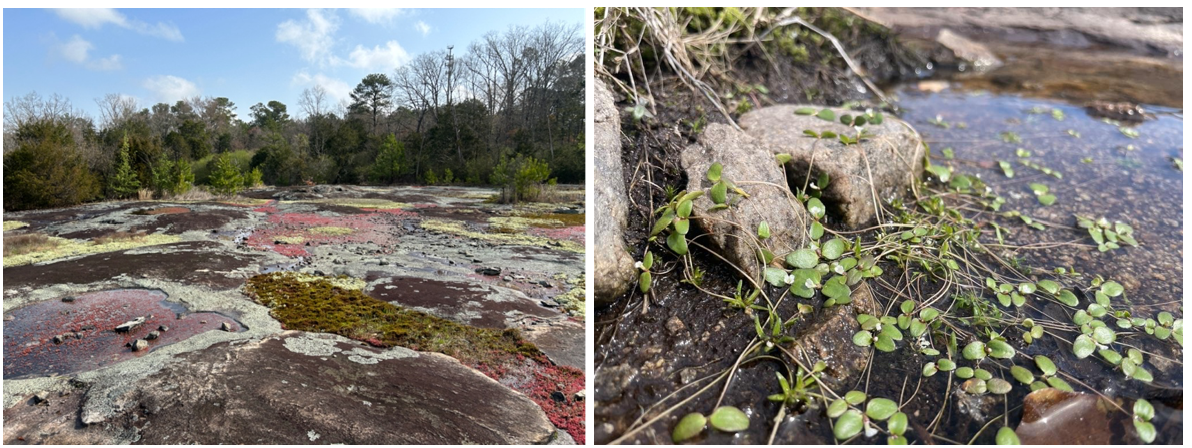
Granite outcrop with rain filled pools and bright red elf-orpine, and snorkelwort in bloom.
We often hear that Earth is undergoing a sixth mass extinction, driven largely by human activity. This crisis can feel distant, conjuring images of tropical deforestation or coral reef collapse. But global biodiversity loss is also accelerating across the continental United States. Biodiversity, the biological richness and variety of species and traits, is fundamental to how ecosystems function. Individual species play critical roles in their ecosystems and their extinction can substantially alter the structure and function of whole ecosystems. Scientists have been studying the loss of biodiversity across ecosystems for decades, and it’s clear that declines in biodiversity disrupt ecosystem-level processes like resource capture, biomass production, decomposition, and nutrient cycling. There is also the inherent value many of us see in biodiversity. You know that feeling you get when you stand before a vast monoculture of corn? Compare that to how you feel standing in a verdant forest with a symphony of birds and budding understory herbs. The earthling in you may not need to translate the outputs of biodiversity into economics to cherish the value of species conservation.
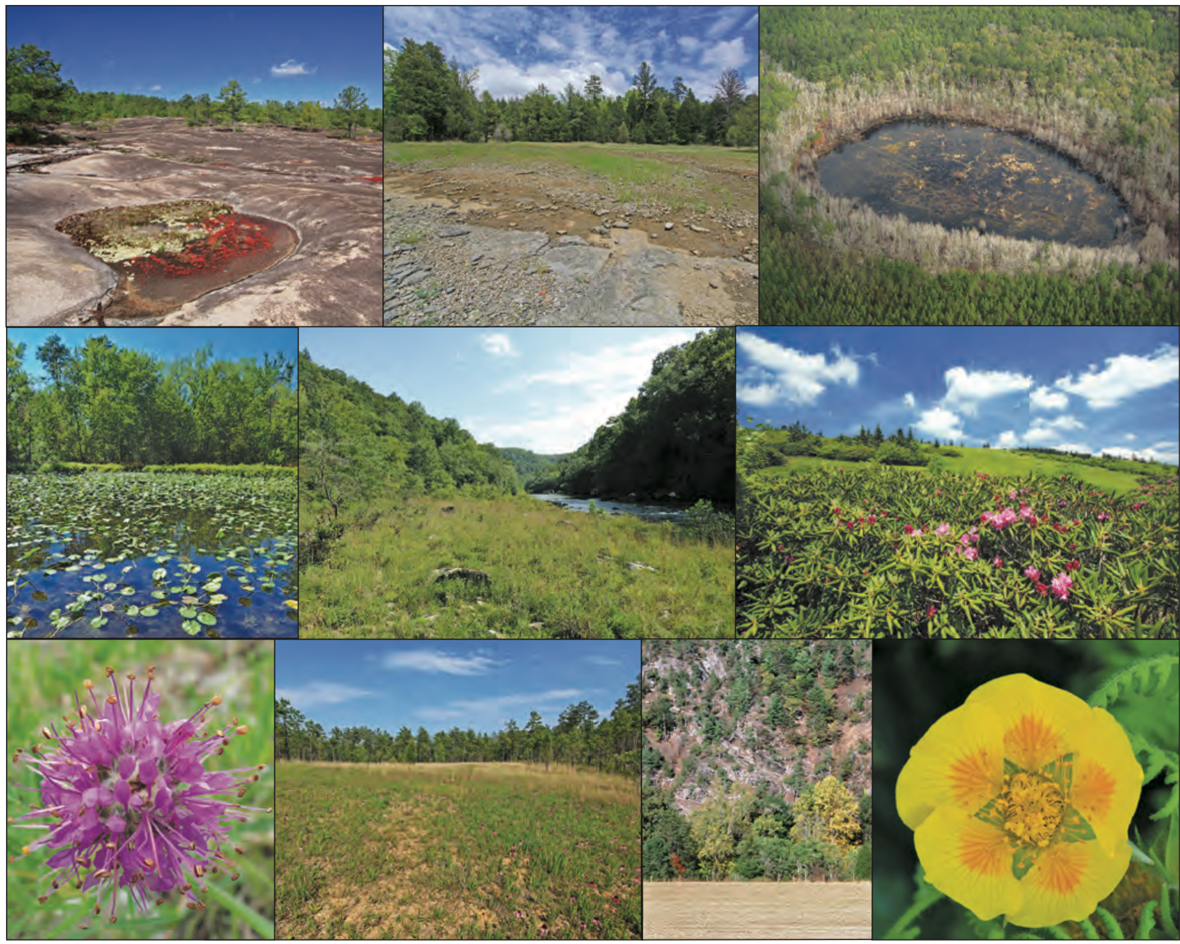
Ecological islands in the southeastern United States from top to bottom, left to right: (granite outcrop, cedar glade, Carolina bay, karst-depression wetland, limestone prairie, high-elevation bald of the southern Appalachian mountains, Dalea gattingeri in limestone cedar glade, xeric limestone prairie, Mid-Appalachian shale barren, Geum radiatum on a high-elevation outcrop. (Cartwright, J.M., and Wolfe, W.J., 2016, Insular ecosystems of the southeastern United States—A regional synthesis to support biodiversity conservation in a changing climate: U.S. Geological Survey Professional Paper 1828, 162 p., https://dx.doi.org/10.3133/pp1828.)
One conservation strategy to combat rapid extinction is focusing on biodiversity hotspots – places with high concentrations of endemic species with an exceptional risk of losing habitat. The insular nature of an ecological island often leads to high levels of biodiversity. This is especially true in the southeastern United States which boasts many unique examples (granite outcrops, shamelessly, may be my favorite). Norman Myers, one of the first to adopt the phrase biodiversity hotspots, reminds us that “by saving the most species at the least cost, the hotspots approach offers one good way to set conservation priorities”. But ecological islands, and their endemic species, are also inherently vulnerable. For an ecological island, a single bulldozer, or prolonged drought is more than a minor disturbance, it can constitute an extinction event to a local population that has slim chances of establishing elsewhere. But why does being an “island” create such a biological treasure trove in the first place?
A place like the Galapagos Islands is a well- known example of a biodiversity hotspot, and provides a clear case study of the ecological implications that come with being an island. Home to marine iguanas, flightless cormorants and giant tortoises, the islands’ physical isolation has allowed a diversity of species to evolve. The ancestors of the plants and animals in these islands today evolved their uniqueness in large part because of their isolation. These same principles can extend to “islands” on land. As beautifully outlined by Jennifer Cartwright and William Wolfe at the U.S. Geological Survey, five key features make an ecological island.
First, they are geographically discrete, forming naturally isolated patches from one another. Second, they are highly specific to some form of geology – think specific bed rock or unique soil types. Third, they host a suite of endemic plants often found nowhere else. Fourth, they have harsh conditions that often force plants to favor stress tolerance over competitive strength. And lastly, the edges of their habitats butt against contrasting habitat, acting as a wall. For a plant on a granite outcrop, crossing the surrounding forests, asphalt, or suburbia is as significant a barrier as the Pacific is to a flightless bird (looking at you, cormorant of the Galapagos). This isolation may restrict gene pools, forcing populations to evolve in a vacuum. Take snorkelwort, which sprouts in thin veneers of soil during the harsh winter– it has claimed the time and place where nothing else can grow. Or the elf-orpine, a dramatically red succulent that thrives in scorched cracks of granite. Luckily for us, this transforms an often-overlooked landscape into a Seussical wonder come winter.
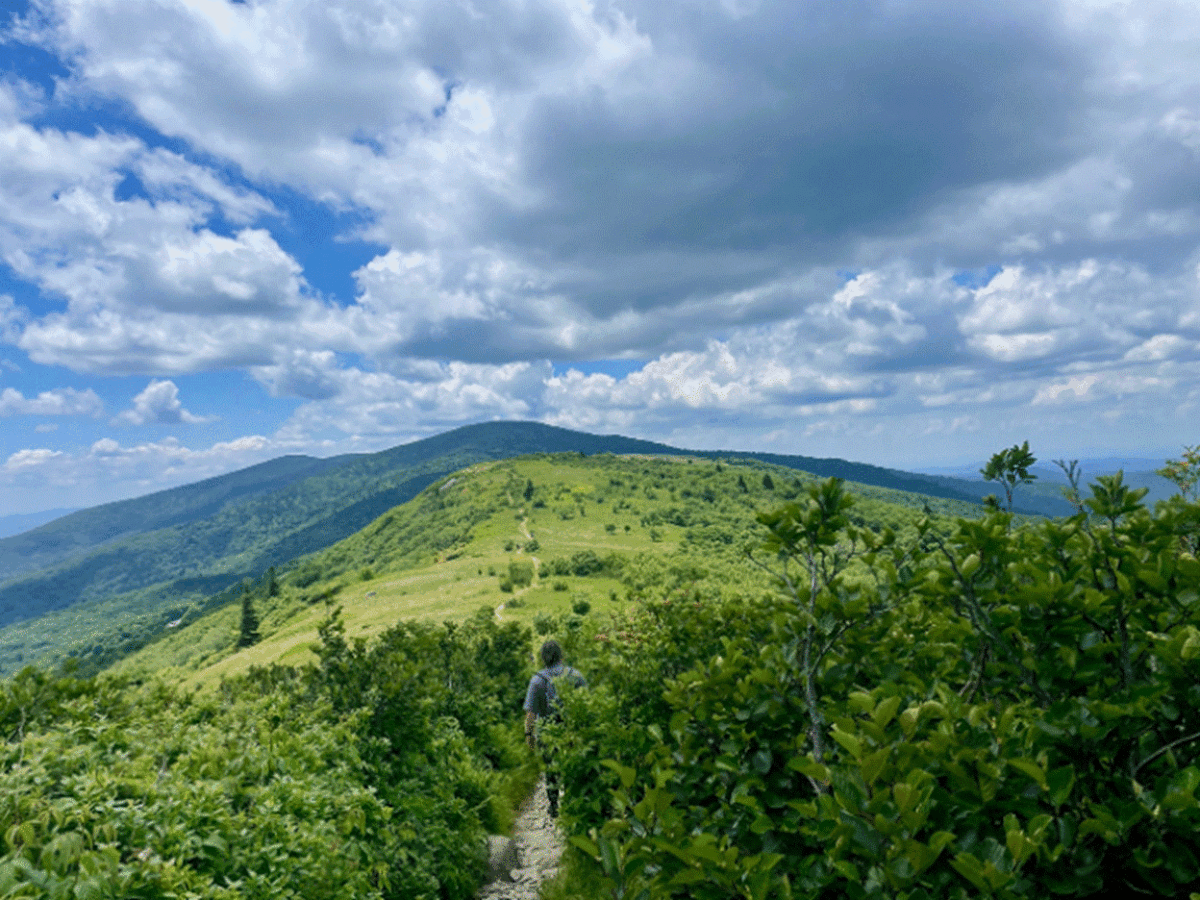
High-elevation grassy balds of the southern Appalachian Mountains in Tennessee.
Now, for those of us who have yet to be invited on a trip to the Galapagos, this isolated structure, and the dynamics it creates, exists on land, too. Granite outcrops, Carolina bays, limestone prairies, and rocky summits of the Southern Appalachian mountains, function both as small islands and biodiversity hotspots right here in the South. The unusually stressful microhabitats like thin soils in granite outcrop pools, limited nutrients in Carolina Bays, or the extreme exposure of high elevation rock faces, contribute to the high levels of biodiversity booming in the southeast. While you may not find 17 species of finches, the assemblages of wetland species, swathes of drought-tolerant warm-season grasses, and federally protected blazing flowers clinging to clifftops have established in these habitats. And you don’t need a boat or a plane to reach them – you can drive to these.
Here are some examples of where you can check different ecological islands, most of which are under some kind of conservation and open to the public.
– Granite outcrops – Rock and Shoals in Athens, Georgia; Arabia Mountain and Stone Mountain, Georgia
– Carolina bays – Carolina Bay Nature Preserve, South Carolina; Jones Lake State Park, North Carolina
– High-elevation rocky summits of Southern Appalachian Mountains – Craggy Gardens, North Carolina; Grandfather Mountain, North Carolina
– High-elevation grassy balds – Roan Highlands, Pisgah and Cherokee National Forests, North Carolina & Tennessee;
– Limestone cedar glades – Chickamauga and Chattanooga National Military Park, Georgia; Barrens State Natural Area, Rutherford County, Tennessee
– Xeric limestone prairies – Coosa Valley Prairies, Georgia; Bibb County Glades Preserve, Alabama
– Karst-depression wetlands – Harriston Ponds, Virginia; Cedar Hill Swamp, Tennessee
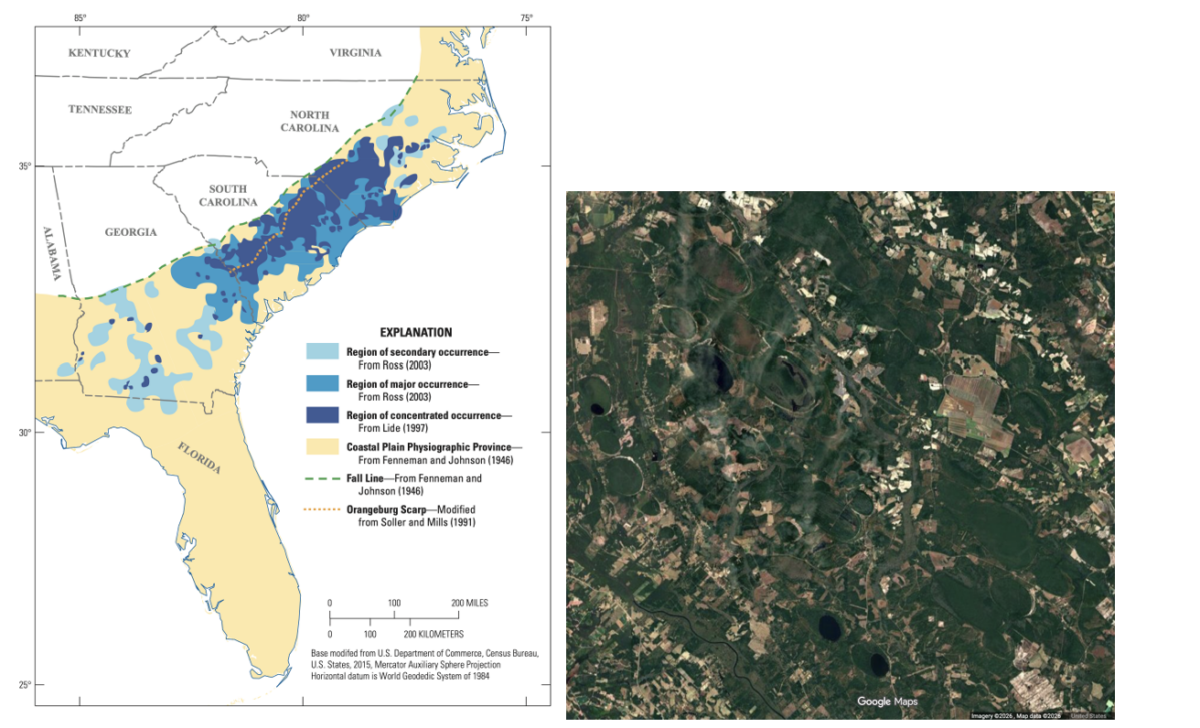
Geographic distribution of Carolina bays from Cartwright & Wolfe (2016), and a Google Maps screenshot showing the distinction of these elliptic habitats across the landscape in North Carolina.
Despite being specialized to stressful or extreme environments, it’s not clear that these specialists will have an edge in the face of climate change. It could be that subtle disruptions can have outsized effects of these species with narrow ecological niches. Climate change may weaken the stress of a stressful environment, allowing for competitors to establish, pushing out the stress-adapted endemic flora. Alternatively, climate change could exacerbate the stressful environment so that even those plants most adapted to the extreme environment can’t keep up. These species are limited in the habitats they can grow in, and our local “islands” are threatened. With no other place to go, losing even a small portion of habitat to increasing urban development or the rapid influx of resource-consuming data centers, poses a significant threat. For granite outcrops, all known extinctions of their most rare plants have been due to destruction directly from quarrying projects. Once these “islands” are gone, the species they harbor are gone. It is a stark reminder that biodiversity conservation is not just a distant, global challenge, but an urgent local one.
Thankfully, the treasure of these unique habitats has been known for ages and organizations like The Nature Conservancy and regional land trusts are dedicated to preserving and stewarding the conservation of these patches of land. Research groups like the Southeast Climate Adaptation Science Center are joining the minds of scientists, with the resources of the U.S. Geological Survey, to implement Tribal-led climate change adaptation planning to address the nuanced impacts of climate change on southeastern habitats. Preserving land and researching the current and future changes is key. These ecosystems remind us that while biodiversity conservation is a global issue, it is in large part a result of local impact. Increasing the awareness and love for our local biodiverse ecosystems is our best bet to ensure their persistence in our changing world. That’s where you, dear reader, come in.
You can get involved by joining local native plant groups, supporting state parks, or volunteering for habitat restoration projects. The needs of each system are unique and there are people working on conserving them – find them and see how you can help. Groups like theGeorgia Plant Conservation Alliance, Birds Georgia, North Carolina’s Friends of Plants Conservation, Southeastern Grasslands Institute, and the Southeastern Plant Conservation Alliance, focus on conserving species and habitats and rely on dedicated members and sponsors.
The effort to slow species loss depends not just on protecting the distant rainforests or coral reefs, but also on recognizing and conserving the unique habitats in our regions. Protecting them begins with noticing them.
About the Author

Anna is completing her PhD at the University of Georgia in Dr. Megan DeMarche’s lab. She studies the ecological and evolutionary patterns of population dynamics, mostly focusing on rare plants of conservation concern. In addition to research, she loves exploring the world through writing and reading, and likes to exercise all facets of her creativity.