Many children’s first exposure to biology is through the board game Operation, a nerve-wracking game where players perform open heart surgery on the board. While it is not the most scientifically accurate game, it does introduce some medical jargon in a playful way, like a Charlie horse, Adam’s apple, and funny bone. As we get older, the value of games is de-emphasized, and we have to “get serious” and study more. But what if we used board games as a tool for learning STEM subjects? This is what game-based learning is about–developing games to teach concepts. Game-based learning incorporates lessons through the act of play, collaboration, and problem-solving. At the collegiate level, studies have shown that classrooms that use game-based learning techniques see an improvement of test scores, deeper understanding of the material, and better appreciation of the content. However, outside of the classroom, there are not a lot of board games that are designed with game-based learning in mind. Addressing this gap by developing board games that use real life scientific principles, that still appeals to the gaming community, could lead to more comprehensive understanding of STEM topics. Currently on the market is a popular game called Pandemic that is conceptually about stopping infectious diseases. Pandemic was not made with game-based learning in mind, but it provides a useful model on how board games can be used as instructional material.
Overview of Pandemic
Pandemic, a cooperative board game designed by Matt Leacock, simulates the spread of four diseases, with two to four players traveling around the world to cure the diseases before too many outbreaks occur. The players can assume one of seven roles (dispatcher, medic, scientist, researcher, operations expert, contingency planner, or quarantine specialist) where all the players start in Atlanta, Georgia, which is the location of the Centers for Disease Control and Prevention (CDC). Given the theme of the game, one would think that the game components could teach concepts related to epidemiology, and it does in certain aspects, but it lacks detailed information to be truly educational.
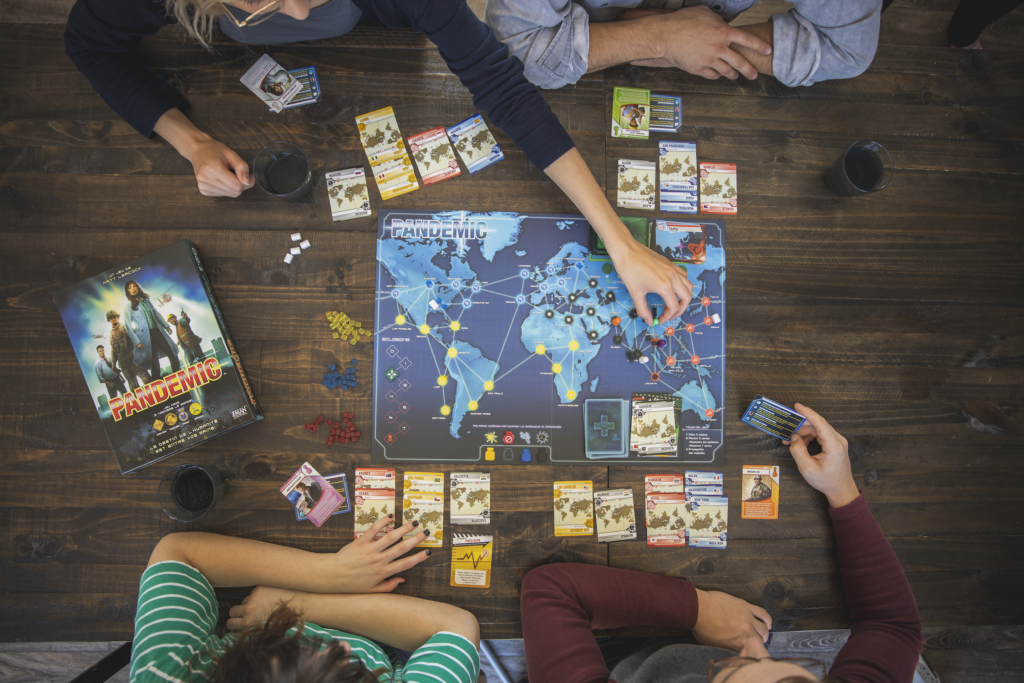
Pandemic Board Game https://www.zmangames.com/game/pandemic/
Pandemic has several advantages as a teaching aid. It is good at facilitating teamwork. As a cooperative board game, players need to communicate and utilize each character’s unique abilities to contribute to group strategies. Pandemic also integrates problem solving skills by encouraging students to come up with strategies and unique solutions; players need to be able to treat diseases before they spread but also anticipate where the next outbreak can occur. They have to use their limited resources and turns to maximize their abilities. Another aspect that makes Pandemic a good teaching aid is how it portrays the geographical factors that influence the spread and treatment of diseases. Disease markers are placed on specific cities but also can spread to nearby cities– similar to how an actual disease spreads. Players can only move to adjacent cities as an example of how treatment can be delayed if it’s too far from a research center.
However, Pandemic has limitations as a teaching aid. There are four different diseases, but they each behave the same way– same spread of disease and same method of curing it. Players just need to meet certain requirements four times to win the game. In real life, diseases have different rates of infection: the flu spreads relatively quickly, but tuberculosis takes longer to spread. The flu is also faster to treat and detect whereas tuberculosis can be dormant before becoming symptomatic and takes months to treat. Another limitation is the simplification of each player’s role so that the game is not bogged down by the complexities of the role. For example, the medic role allows for the removal of disease cubes more efficiently than other players, but does not address how a real-life medic would take vitals, perform diagnoses, and administer aid. This might be an unfair criticism because this game was not designed with learning in mind, but let’s explore how Pandemic or any game could be designed in a way that facilitates learning.
Game-based Learning Design
How practical would using board games as a study aid outside the classroom be? How could board games be utilized as a learning strategy? Benjamin Bloom created a hierarchy of learning that teachers have used for decades to assess how deep a student’s comprehension is. There are six levels of comprehension progressing from most basic to complex: remembering, understanding, applying, analyzing, evaluating, and creating. In classrooms, a common studying technique to remember (the first level of the Bloom’s hierarchy) concepts is to use flashcards as a way to check where your memory is deficient. Rote memory, such as using flash cards in a repetitive manner, however, does not allow students mastery of the concept. To go deeper into a topic, a student needs to go beyond remembering and understanding.
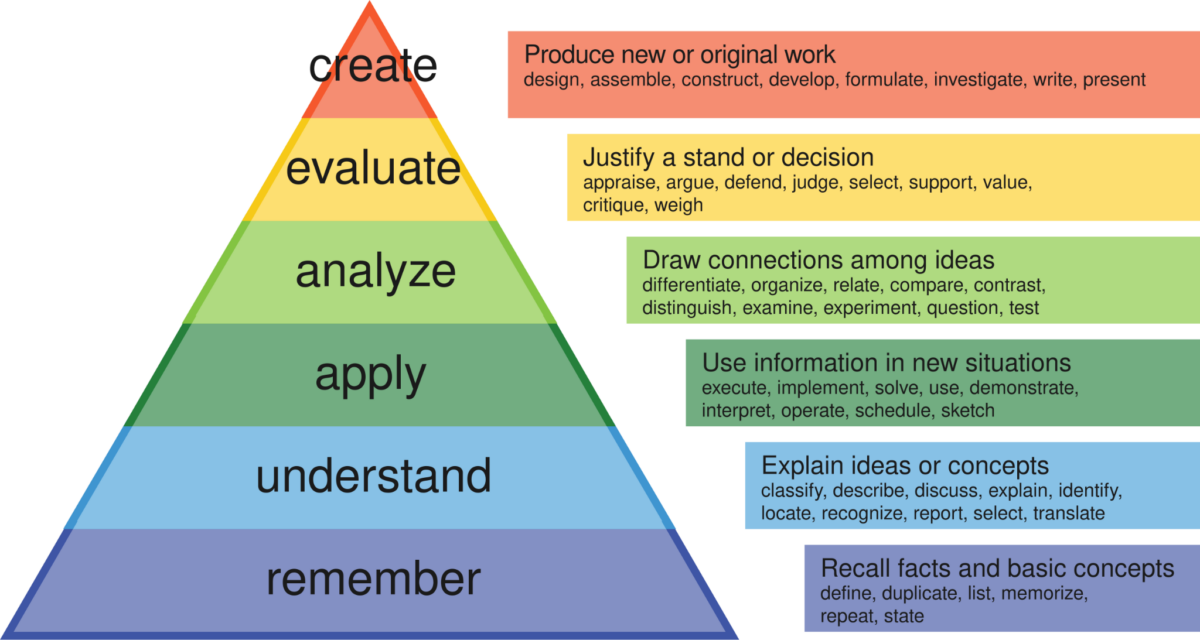
By Tidema – Own work, CC BY 4.0, https://commons.wikimedia.org/w/index.php?curid=152872571
Stages in the Bloom’s hierarchy such as applying, analyzing, evaluating, and creating are already fundamentals in game play, especially when a game requires strategizing. As an example of how Bloom’s hierarchy naturally fits into games, players have to understand (second tier) how the game works to apply (third tier) the rules. Players analyze the state of the game to determine a path towards victory. The pedagogical issue with Pandemic is that the rules being applied are not based in science. For example, the rule that a disease can be cured with a certain number of cards is not how a disease is cured. In the game, players roleplay traveling and researching in cities to exchange information with each other to get the prerequisite cards. Furthermore, the infrastructure for the type of research that is needed for developing cures is lacking and unique to each disease.
To redesign Pandemic in a way that facilitates learning would require the use of more concepts found in the classroom. Let’s go back to the issue that in this game, all the diseases spread at equal rates of infection. In an epidemiology class, students learn about reproduction number (R0) as a way to describe how fast an infection spreads. Chickenpox is very contagious for the unvaccinated and has a R0 value of 10-12; for non-immunocompromised people, chickenpox decreases the quality of life but is survivable. Ebola is not as contagious and has an R0 of 1.4-1.8; while not as contagious, if you get Ebola, you have a 50/50 chance of surviving the disease (in some outbreaks, over 90% of infected died from the disease). The game Pandemic could take well characterized illnesses and use the rules of their outbreak as a way to bring realism to the game. For example, a way to modulate the game would be to differentiate the number of disease cubes that is added for each disease; e.g. if a “yellow” or “red” disease cube needs to be added, have the rules be that the “yellow” disease has two cubes placed (for more infectious d and only one “red” disease cube placed to emulate R0 values.
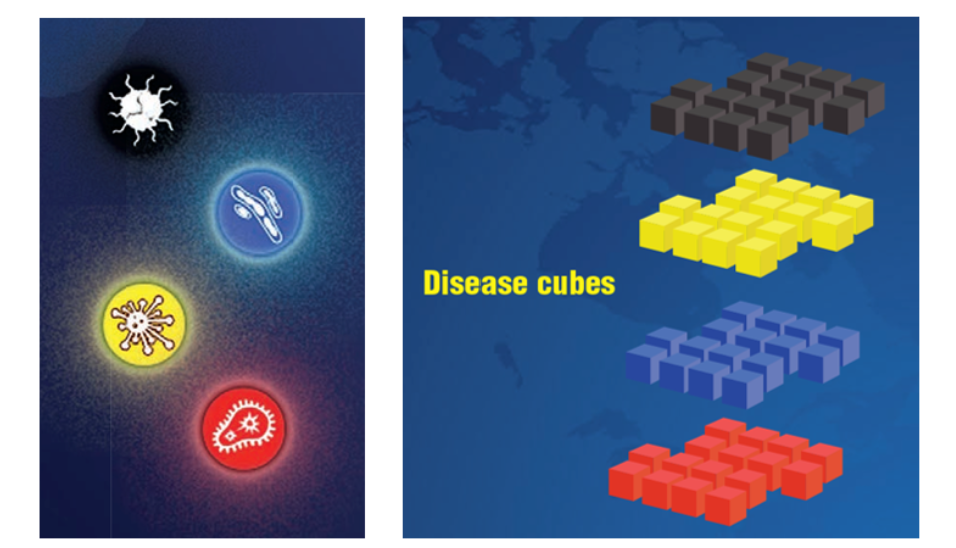
Disease cubes: adapted from the Pandemic Rule Book
Disease cubes: adapted from the Pandemic Rule Book
If someone were to design a game to help students learn concepts, what are things they should consider? Based on my own experiences, if someone designs a game that they want to be educational and useful, it needs to be fun to play, hold the audience’s attention, but also realistic to ensure true learning is done. Otherwise a student would just make flashcards and not go beyond remembering (Bloom’s 1st tier). Pandemic is a wonderful game to play, but only has the wrapping of epidemiology, not the substance as it was not designed to be a learning-based game. There are some games currently available that are educational (Geneblock and Microbe Kombat) but the opportunity to create strategies and to analyze the game state needed to win are simplistic with little opportunity for strategizing.
Board games designed with learning in mind should be playable for the intended age group but should have rules that more closely reflect the concept the game is about. If a game is about birds, then a diet and habitat for hawks should be different than for swans to reflect the real-life differences (see Wingspan). I would also add that if there are modifications to make the game play run more smoothly, authors of games should have an appendix detailing the changes and why they were made. Furthermore, to work as a better learning tool, an appendix could also have questions about the game. For example, “how are diseases spread in the game similar in real-life, how are they different?” would reinforce concepts from the game but also acknowledge where the game is limited.
Research in game-based learning is a nascent field of study. At UGA, Dr. Amy Ellis researches in a related field, playful math. She does qualitative research about how play can be used as a tool to facilitate learning mathematical principals. In playful math, she develops games and fun tasks utilizing middle-school math curriculum. Students are presented with a problem, but they get the freedom to solve the problem in whatever way suits them.
In Dr. Ellis’ research she found that “when students solved problems they had developed for themselves, they seemed to experience a sense of ownership, and consequently, an accompanying sense of pride and fun.”
While her research focused on playful math, this should be the goal that any game developer strives for if they’re trying to make educational games.
Dr. Ellis told me “people of all ages learn through play,” and this includes young adults studying at university. I would encourage professors to develop and provide game-based learning for students to supplement their studies outside the classroom and to analyze improvement on exams and classroom participation. How to implement game-based learning most effectively, however, will require more research on games-based learning. In the future, hopefully there will be more board games that balance fun and learning concepts, allowing players to utilize each tier in Bloom’s hierarchy.
About the Author

Ashley is a PhD candidate from the Szymanski Lab. Her research focuses on how the glycobiology of bacteria influences pathogenesis. In her free time, she crochets while listening to audiobooks (usually of the fantasy genre) and plays hours long board games